Conversation
An attractive little 'Vermouth Bar' [1] opened recently five doors down our street. Some will think of it as a 'Vermouth Bar', but for others it is a 'Gift Shop'. It is clearly a good business formula, for the little shop gets quite crowded, even on rainy evenings. We occasionally pop in, just for the fun of it; we enjoy the Galician beer, and chatting with the proprietress and staff, and the chatty strangers; for it is the sort of place where your very proximity overcomes restraint; where a stranger will turn and greet you with a friendly question. You might meet a couple of restauranteurs on holiday from Seattle, or a retired Mexican diplomat.
The latter lives in one of the flats in our building. We greet each other on the stairs, occasionally, and recently on the street also, whereupon we agreed to meet for a Vermouth in the little Vermouth bar. I was excited in anticipation, for I knew Eduardo was fluent in English and I was hoping for some conversation. Nor was I disappointed. Eager to show a non-scientist the fascination of biology I asked Eduardo to visualise an amoeba, 2.5 billion years ago, engulfing a bacterium, the bacterium surviving, symbiotically paying for its keep by supplying the host with 'energy' for it, uniquely, had evolved the trick of obtaining energy from the reduction of oxygen to water. He was appropriately astonished.
Is that not a marvellous vision of the intricacies of the world we live in; a thought to share? [2] That, to this day, animal cells contain a few hundred little particles the size of bacteria, which do all the oxidative respiration for the host cell. Bacteria developed the respiratory chain that can harness the energy in the flow of electrons from hydrogen to oxygen to synthesise ATP from ADP + P. Neither animals nor plants ever learned that trick; but they learned to tame the bacteria/mitochondria/chloroplasts and to live in harmony with then, dividing in synchrony.
I would love to have gone on, sharing this joy; the joy of contemplating and sharing a beautiful concept, a beautiful idea or, indeed, a beautiful object. Surely other fields of human endeavour will have their own 'beautiful thoughts'! How could I encourage the sharing of such.
I remembered a dinner following an AGM when the committee sat round a long table in a country hotel. Someone said to their neighbour: "Tell us your most remarkable experience."
"I saw the Coronation Coach pass by from a balcony near Admiralty Arch".
"I, " said another, "was a ball-girl at Wimbledon once, and was on court when Boris Becker won the cup in 1985."
"I, " ventured a third, "have the inside leg measurement of the late Queen.". Once the absurdity of this had sunk in, he continued. "The House of Lords wished to present the Queen with a correctly made side-saddle, and had to acquire this unusually personal datum."
Could I start in a similarly abrupt manner, and come straight out with an invitation like: "Tell me your most beautiful thought." There might be no response, or they might stall a bit, in puzzlement. So, to show them what I had in mind, I could continue:
"I find it utterly amazing that yeast DNA and human DNA so clearly share a common ancestor - some 2 billion years ago [3]. Thus, the respiratory chain of baker's yeast contains an NADH dehydrogenase, a succinate oxidising Complex II, a ubiquinol-oxidising complex III, a soluble cytochrome c, and a cytochrome-c-oxidising complex IV; furthermore these complexes separately and together drive the ATP- hydrolysing Complex V in reverse. In these respects baker's yeast is identical to the typical human cell. The detailed amino-acid composition of individual proteins differ, but the folding and the function of the equivalent yeast and human proteins are the same. Is that not a fascinating concept?"
Were Casey Quinlan present, whom I met as a bird-loving biochemist and wine-waitress when I was in Portland, Oregon, I could imagine her saying:
"I see what you mean. Can I offer you the 'Chapman's Chimney Swifts'. Every September evening for the last forty something years, thousands of swifts gather at sundown in the skies around Chapman's Elementary School in Northwest Portland. This, from 1925 to 2003, was heated by a furnace that exhausted through a tall, octagonal, brick chimney. (Shortly after sundown and for the next half hour, thousand upon thousands of these small birds (18 gms) spiral round the top of the chimney and disappear down into the darkness, where they presumably find a perch on the walls.[4] They are safe inside but vulnerable as they approach the lip of the chimney, because falcons gather to pick off stragglers. Does this qualify as a beautify thought?"
" I would jolly well think so! It is exactly the sort of thing I had in mind." Saying which I could perhaps turn to Eduardo. "Well, you will have met many interesting people and interesting ideas in your diplomatic and academic life. Are you able to see the world as offering us visual or intellectual wonders?" It would be fun if he could have responded something like the fllowing:
"Well, yes; sure. I would like to have been present, for example, at the 1978 Camp David Accords, when Sadat (for Egypt) shook hands with Begin (for Israel), witnessed of course by Jimmy Carter for the USA. But I was not there and, though it was, and still is, a marvel, that accord has become rather diminished by subsequent events. Perhaps I could instead offer you 'Sunset, viewed from the Ubirr Rocks in the Aborigine reserve of Kakadu National Park in northern Australia' [5].
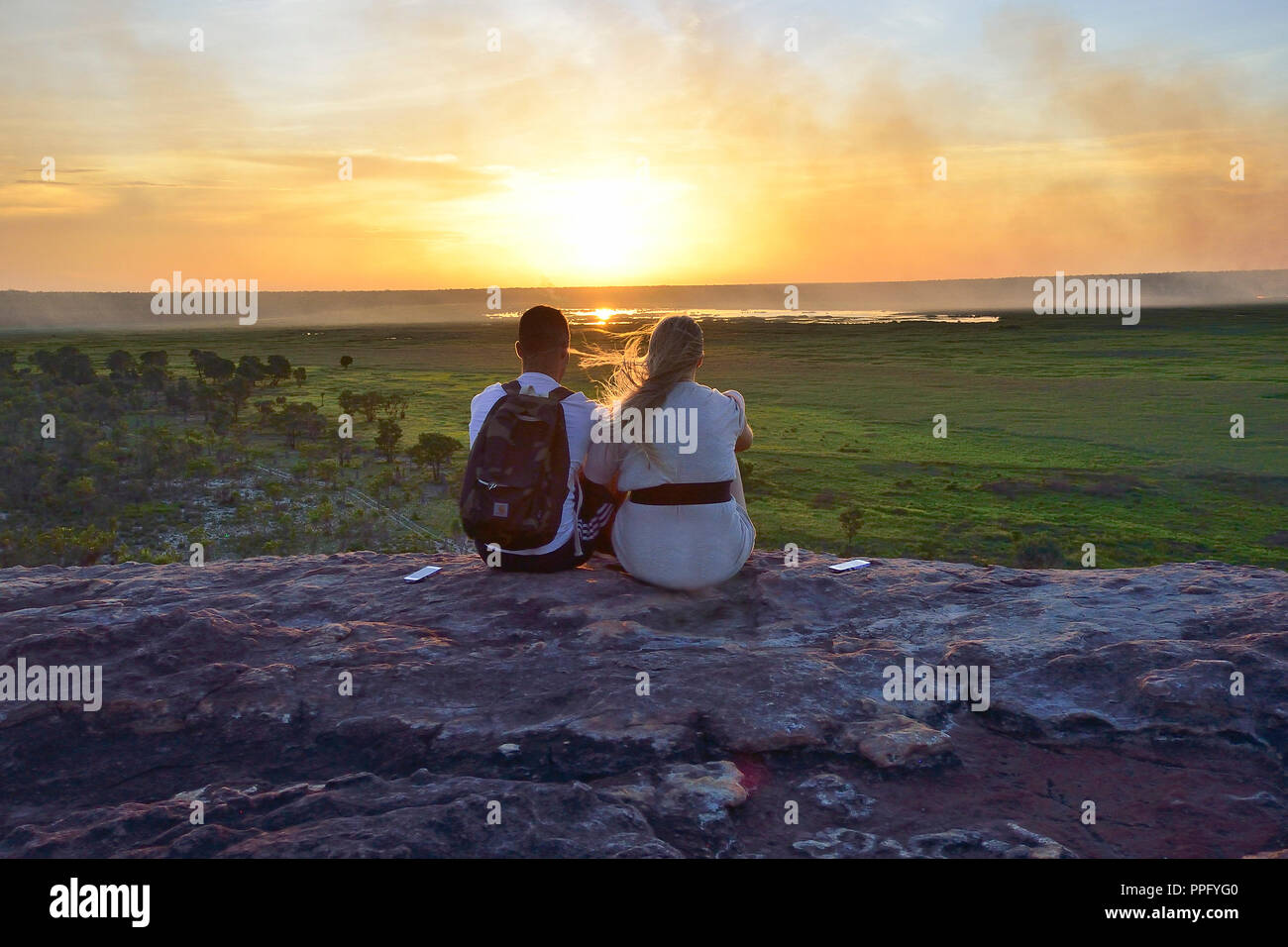
Looking due west from that vantage, you can see distant swamps and billabongs glittering in the light of the setting sun, and the blue smudge of bush fires. You can just about believe the world dips at the horizon. It is a holy place for the Aborigine people and in my experience it has a similar awe-inspiring effect on all who go there. You do not need to believe in magical spirits; it is a place and a time of day that calls to mind our peculiar position on the surface of a gyrating spheroid, held there by the mysterious force of gravity.
I turned to the silent one: "And you Jenny? You have hardly said a word all evening, but have published many peer-reviewed papers. Surely you enjoy thinking?"
She gave a start, uncrossed and recrossed her legs and said: "I am afraid I was not following. I got as far as 'Sunset in Kakadu' when it occurred to me that I had left some towels on a washing line in our roof-garden; with this downpour they will be sodden. That is not a matter of general interest or global significance. I have spare towels in the closet. "
And yet, I realise, there was a vivid quality to her observation that we all understood.
"I believe it was the word "gravity" that caused me to 'jump the rails', as it were, for I cannot conceive of gravity. In my teens I learned that the force between two objects is proportional to the product of their two masses, and inversely proportional to the square of their separation. That is easy to understand; but it does nothing to explain to me what gravity is. Masses explain gravity and gravity explains mass. But how can one mass attract another distant mass? Except it does, and always does".
"Well, thank you; I suppose both the wet towels and gravity are worth thinking about."
References
[1] https://occidentis.blogspot.com/2026/09/the-tailor-at-gelati-8.html.
[2] https://occidentis.blogspot.com/2023/05/time-to-think.html
[3] Cell & Microbiology Molecular & Computational biology - October 28, 2025.
[4] https://birdallianceoregon.org/go-outside/swift-watch/
[5] https://c8.alamy.com/comp/PPFYG0/two-young-people-sit-on-the-rocks-at-ubirr-lookout-to-watch-the-sunset-kakadu-national-park-northern-territory-top-end-australia-PPFYG0.jpg


No comments:
Post a Comment