14 June 2025

On Helices

On Helices

(Part 2 of Nuts & Bolts)

You will recall that some 15 years ago [1] I raised the question "Do modern metric nuts and bolts come loose spontaneously with greater facility than the nuts and bolts of my childhood". I was a little surprised to find no one taking up the enquiry, as it surely affect us all. (By the way, the handle is loose again on the cold tap in my new kitchen, thus defeating a handyman and two trained plumbers!). So, I decided to look further into the matter. 

One useful step forward was identifying a company (BoltScience.com) with a testing jig that will rattle a couple of bolted plates till they loosen. They have not yet (so far as I can see) asked my questions, about metrication, tribology, and groove angle; but I may be able to cajole them into a colaboration. As a second step, I decided to make a deeper study of the helix, because its geometry is fundamental to the questions I am raising. 

At the outset, let me clear up a possible confusion: a spiral staircase is a misnomer. A spiral would lie of the floor. We should talk rather of a helical staircase; c.f. Watson & Crick's double helix. Next, let us remind ourselves of some terms. 

Let h = the (vertical) height of the helix up its long axis, 

Let p = the pitch or lead up the long axis for each turn of the nut. 

Let L = the length of the helix were it unwound and laid flat.

Let c = the circumference of the helix.

Let n = the number of turns; i.e. h/p.

I next wanted to see if I could calculate the area of the two surfaces that are juxtaposed when a nut is threaded on a bolt, the two surfaces between which the friction is generated that prevents the nut loosening; and for that I must calculate L, the length of the thread. 

Not trusting my theoretical powers, I sought to measure L, to check theory. I found my wooden rolling pin (h=400mm), milled to a uniform diameter of 39.8mm which I determined by wrapping a paper strip round the cylinder and cutting it exactly to equal  the circumference (c=125mm). I found that a dressmaker's measuring tape would lie adequately flat against the rolling pin, even when wound round like a ribbon on a May-pole.   
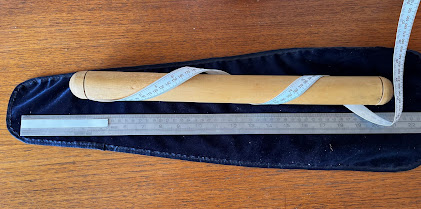


Two extremes are easy. If the tape runs vertically up the pin, L simply equals h. And if the tape went round and round the pin without progressing up the pin at all, L could be infinitely long. I measured the length of tape needed to wind it round one full circle in the 400mm height of the rolling pin. And again with 2 full circles; etc.  

No. of complete circles.  Measured L (mm)

1 417

2 472

3 552

4 646

5 750

With string I could have explored further, but the tape was more convenient; and, lying flat against the rolling pin suggested the next step. With the tape making one complete cycle in the height of the pin, it was easy to see that the rather stiff tape made a precise angle (𝛉) against the vertical axis, which it maintained all the way round the pin. I could find L by applying Pythagoras's theorem to the little right-angled triangle: base = 𝛿c; height = 𝛿h; hypotenuse = 𝛿L.; and assume that the relations held all the way up. Furthermore, the angle off the axis (𝛉) can be calculated by applying trigonometric functions.  For a single circle of the rolling pin, the cos of the angle (𝛉) of the thread to the axis is 'adjacent/hypotenuse' = 400/417, so 𝛉 = 17ΒΊ; for two circles of the pin the angle between thread and axis (𝛉) is 32ΒΊ [cos(32ΒΊ)=400/472]. Likewise, the related small angle (90ΒΊ - π›‰) is arctan (pitch/circumference). 

For each circle of the pin:

L2 = c2 + p2

But n (the number of turns) = h/p so, for a multi-turn helix we can predict: 

L = h/p x √(c2 + p2)

I add these predictions to my table. 

No. of  circles.  Measured L (mm) Calculated L (mm)

1 417 419

2 472 470

3 552 548

4 646 640

5 750 742


That is all very satisfying. And is a step towards calculating the area of the two mated surfaces between nut and bolt where friction prevents loosening. 


REFERENCE

[1] https://occidentis.blogspot.com/2010/06/nuts-and-bolts.html

09 June 2025

Blackbirds or Pigeons

 Blackbirds or Pigeons

I turned to the woman on the seat behind me as the bus waited at the traffic lights. We had recognised each other. She normally remembers my name, which is flattering. On this occasion I also remembered her name.

"Are you coming home from working at the pharmacy?" I asked, though it was mid-afternoon on a Saturday. 

" No! From the gym." she told me, and now that I noticed it, there was a touch of pride as well as of tiredness in her voice. 

"A therapeutic workout?" I suggested, to which she grudgingly assented.

What is life for, after all? You work till you are tired, raise kids, grow old and die. She helps people already, by dispensing medicines, but would dearly like to become a qualified counsellor, and listen instead to people's woes. It is amusing how small a shift in perspective will change a chore into a calling.

"And I should like to travel", she told me. 

I mused a while. Should I tell her about the blackbirds and the pigeons? Would it amuse her, lighten her load?

A number of bird species live in or near my small garden, and carry on their business there.

Robins, wrens, dunnocks, tits and sparrows flit about, more or less unseen. I occasionally glimpse fluttering wings, or hear a snatch of song from deep in dense foliage. Starlings strut about on the ridge tiles opposite, chattering their comments on the scene below; but they seldom come down to the garden. So, it is mostly the larger birds that concern me here; the blackbirds and the pigeons. 

I have often watched a hen blackbird picking raspberries off the canes I grow in two giant pots against the sun-soaked fence. She crouches on the flag-stones looking up at the canes above her till she finds a ripe berry, then leaps up and snatches at the fruit to fly off with it in her beak. I am fairly relaxed about her depredations. When I go down and take a look, I find no fruit worth picking; nothing except tiny, unripe, fragments. She must be hungry. Perhaps she has a nest-full of chicks nearby. 

The male blackbird is often seen on the lawn, ear cocked as though to hear the rasping noise of subterranean worms, or swooping low across the lawn, with a long, thin, worm in his beak; further evidence of hungry nestlings. Blackbirds are territorial. Each pair has its garden, which they must defends against poachers. Hence the valiant singing with which the males fill the gloaming (that evening stillness between sunset and nightfall). Blackbirds strike me as good parents. 

Not so the pigeons. I have never seen a hungry pigeon. They always seem well-fed, and idle; showing only a dilettante's interest in a poppy seed on the flagstones or a couple of ants on the lawn. They are strong flyers and can feed anywhere in the parish. I resent their sleek plumpness, seeming to be perfectly aware that they are now a protected species. And I resent even more the amount of time they spend love-making. I don't mind when they sit quietly 'kissing'; it seems touchingly human. But I dislike their posturing and crooning and, above all, the noisy flapping of their wings as the cock repeatedly tries to tread his hen.  Or when he indulges in showy combat with rival cocks.

  "But the essence of life is finding food, and rearing a family" I suggested, "like the blackbirds. Not just strutting about making love, like the pigeons". 

"Humph", she retorted. 

"Swallows and swifts are great travellers", I mused. "There are almost none nesting here this year, but I saw great numbers of each last weekin Croatia."  

"I would really love to travel", she repeated.     


26 March 2025

Behind the Hedge

 Behind the Hedge

I have an old violin I bought in 1972 and used frequently for playing in pubs and folk clubs. Its distinguishing feature is scratched into the varnish of the back – 2£. But it plays freely. The low clearance at the nut makes stopping easy. Through frequent use I am familiar with the curve of the bridge, and the separation of the strings. It has history**. But last summer it came unglued, and was inexpertly repaired by a wife-husband team who deal mostly with school violins. And now the pegs do not hold the tension of the strings. Caswells Strings is a much bigger concern with a well stocked showroom in town. My niece bought a violin from them 7 years ago and, more recently, I bought a 'mute' there. But I had not seen any sign of a 'craftsman' on their premises.  

I looked online for local violin makers (as I had some years ago in Mexico City – see my blog-post), and found an entry from a firm I had never heard of, in a tiny hamlet I had passed through many times; a mere handful of houses and a letterbox. I telephoned to make an appointment and was given instructions on how to find the "workshop", by turning off the lane 50 yards before the hamlet. 

I could not have been more surprised if I had found behind the hedge, in that little hamlet, a fully equipped and well manned space ship. As the door opened I heard a faint hum, as from the engines; two men in aprons; it could be about to take off.

One man was bent over the body of a double bass gripped in a large vice and was preparing to fit a new neck to the block. The other I must have caught between jobs, for he had nothing in his hands at the moment I entered. I looked around me, astonished.

It is amusing that the firm advertises itself as 'Violin Makers', for they clearly specialise in the less romantic double-bass, and more often repair those than construct them from scratch. The founder of the firm had for many years been a professional bass player with a London orchestra till he retired some 30 years ago, to open the workshop. The 'firm' moved up from Henley 25 years ago. 

        There were some twenty basses lining the walls in various states of repair, but also a cello in the process of construction and a solitary violin, ready varnished but as yet unplayed.  

'David' looked at my pegs, applied chalk to all, gently reamed one peg-hole, trimmed a whisker off its peg to make it more circular in section, and drilled a new hole for the string further up the shank. All inside 40 minutes.  


(** If you are interested in the story of how I came by my old 2£ fiddle, drop me a line to: cawstein@gmail.com)

19 March 2025

Padraig O'Reilly

 Padraig O'Reilly


As I approached the bus-stop this morning, hat-less and care-free, enjoying the noon-day sunshine, I looked around for my new friend Padraig O'Reilly. It has become one of my routines on alternate Wednesdays, after the coffee-house discussion in the Old Mill. This smartly turned-out young man caught my eye a few weeks back with his rubber knee-pads,  leather belt, high-boots and his taut, kung-foo, readiness. I was too polite to ask his business, but too curious to ignore his evident plea to be noticed. Perhaps a fantasy warrior. Or a prisoner on early release for good-behaviour. 

He had responded most courteously to my greeting in a lovely Irish lilt. I soon gathered his destination, his preference for the early shift, his ambitious saving-plans, to learn to drive and then to buy a car. He wanted to know the hours I used to work (9 – 5 in my case, or 8–6 when I accounted for travel). And my regular breakfast. I was charmed by his openness, and interest. I learned of his 'traveller' in-laws; and out-laws, as the case might be.  I realised that I was being measured against his own experience. 

This morning I complimented him on his neatness and he, in return, praised my turnout. He reached for a note-book in one of the conspicuous pockets hanging from his leather belt. As he thumbed through to the back page, I remembered that writing was one of his prouder accomplishments. There he had listed five lotteries, including Euro-millions, Set-for-Life and the "Post-code" Lottery. In these he had decided to invest £50 a week.  Forty pounds, he corrected himself, sheepishly, as he crossed out the "post-code" lottery; someone must have told him that it did not operate like the others. 

"You are feeling lucky, are you?" I teased. "A feeling in your bones?"

"Some years ago", I continued, "I thought I might run a lottery in which the punters would all give me £2 a week, I would pocket one pound and give them £1 back. For that is all these other lotteries are doing, isn't it," I continued; "except that they give a million pounds to one guy and nothing at all to a million other guys. (Maybe they give 50p to charity; and pay tax on the 50p they keep.) 

"You can't win if you don't enter", he replied. 

"Very true, very true," I conceded. "What would you say to this, then: every week you give me £50;  and after 4 weeks I give you £200?"

"You have to stick to the limits you can afford", he told me. "Never go over". 

"That is good advice" I agreed. 

He waved me onto the bus ahead of him, and I accepted. He likes to sit up front by the driver; by the door. 


Four weeks later, Easter Friday afternoon,  I was queuing in the post office behind three men all of whom were there simply to buy a lottery ticket and a scratch card. The man at the front handed over £4.50 which he had ready as coins in his hand. I, still on mission, was tut-tutting to myself when my ear was caught by the conversation of two women behind me. One was telling the other that she knew of a chap who won a million pounds on a scratch card. Bought a house, the money soon gone. 

I realised that it was I that did not understand lotteries. Oh, I understood the maths alright. It was the hour or two of hope, of dreaming, that was beyond my emotional register.  No imagination, that was my problem.

As I packed my purchases into my bag I turned to the women.

"I was excited to overhear that your friend won a million pounds", I said; "One in a million, I suppose." 

"Yeh, literally!" she replied.

Levelling Down

 Education Act – is it levelling down?

Lord Harris of Peckham (founder of the Harris Federation which runs over 50 academies) wrote in the Times “Failing schools are letting people down. We have to make sure we do not let our children down. The best way to address failing schools is to allow good academies to take over, and give them the freedoms that have made them successful." “Taking these away is madness."

In BBC's 'Today' programme (18th March 2025) Justin Webb quizzed Pat McFadden on the government's Education Act, currently going through parliament, challenging the government's negative attitude to Academies. It seemed to me that he was charging the government with spoiling successful schools. 

The words that seemed to elude him, the charge, was that of "levelling down". 

14 March 2025

The Girl on the Bus

 The Girl on the Bus

I celebrated my retirement from Newcastle University by buying a round-the-world plane ticket, and arranging to work for a year in a biochemisty laboratory in Taiwan. A kind friend, gave me a 'Travel Diary' in which to capture my thoughts and impressions; though she by no means understood why I was leaving her for a year.  I found it, the other day, gazed at the cover for a few moments, before opening and leafing through a few pages. I stopped at an entry titled "The Girl on the Bus" where a book-mark fell out. The words on the page evoked forgotten memories. 

It was three days before Christmas. Though I had been warned several times that Christmas and New Year were foreign concepts and very minor days in the Taiwanese calendar, nevertheless there was a hint of holiday in the air. And it was a Sunday. I decided to make a modest trip out of the city of Taipei, perhaps to the extreme north of the island. I took the mass-transit-railway to its westerly terminus at Tamsui. From there I could catch a bus to take me round the coast to Shi-men. I would have no idea when to get off the bus except by keeping an eye on my watch and assuming the bus was running to timetable; an hour and 10 minutes to Shi-men.

The ramshackle bus set off from Tamsui bus-station shortly before 11.30. I, an obvious foreigner in his early sixties, had a good window seat on the left side of the bus. A considerable number of people got on at the next stop, and a local girl in her mid-twenties came and sat by me. 

I looked out seaward at the passing view, with my chin in my hand. We swayed against each other occasionally but it did not seem to matter; we had room enough; it was only momentary. 

After 20 minutes the girl started to search for something in her bag, and eventually brought out a little bookmark, or 'favour', made out of a dried leaf-skeleton decorated with bright yellow straw flowers, green straw leaves and a tiny blue straw butterfly. This she offered to me. I have it still, twenty years on, as this bookmark in my travel diary.

I am sure that my face fully expressed my surprise, gratitude, and embarrassment. I had become accustomed, over the months, to conversing almost without words, using glances, gestures, and guesses. Imagine me, in a barbershop,  requesting a trim and declining a massage, a shave, and a facial, all in gestures. 

"It is Chinese" she said in cautious English. 

"Indeed, very Chinese!" I agreed, delighted at the opening thus created. We got to talking, occasionally, and carefully. I told her I was was going to 'Shi-men'. She thought I would arrive at about 12.35. She was going to San-zhi. 

"I am meeting someone", she confided. "I have a 'date' ",  

"Really?", I asked, rhetorically.  I am sure that from my face she could read my pleasure, and perhaps my surprise. Though not, perhaps, their cause. For it was her trusting directness that surprised and charmed me. I am sure my face must have beamed my happiness, and gratitude; but could she read there my best wishes for her future happiness in this exciting development?

13 March 2025

No NATO boots in Ukraine

To the Editor of The Guardian,
Dear Sir,

No NATO boots in Ukraine

     It seems clear that Russia regards the presence of NATO (or European Union) troops in Ukraine as unacceptable conditions for long term peace, whereas we (in the West) think it perfectly reasonable, and Ukraine thinks it is essential. All that is understandable. RΓ΄les reversed, we would think the same. Indeed we DID think the same, when the Russians placed missiles on Cuba. We were very lucky to have had some adequately flexible diplomats around at that time. 

    So I believe that this point should be conceded. It would have to work both ways, of course. NO NATO TROOPS IN UKRAINE AND NO RUSSIAN TROOPS IN UKRAINE. That is the only way to understand a neutral buffer zone. 

    (The "Cuban Missile Crisis" of 16-28 October 1962, was resolved on 28th October, by the Soviets dismantling their offensive weapons in Cuba, subject to United Nations verification, in exchange for a public declaration by the US agreeing not to invade Cuba again. The US also dismantled their missiles in Turkey. That crisis showed, de facto, that hostile missiles in Cuba were as unacceptable to the US as missiles in Turkey were to the USSR.  It similarly demonstrated that the US did not have the liberty to invade Cuba if the USSR did not have the liberty to protect Cuba. )

    It is axiomatic that our allies  are reasonable and can be trusted, while 'the enemy' is un-reasonable and un-trustworthy; such is the "the distorting lens of inevitable prejudice"

    A logician can easily see what a politician and a citizen cannot: that our enemy will be liable to the same distortion and see the same asymmetry.

   (Ranyard West, in his last book ("International Law and Psychology", 1974) described a technique, which he called "inversion-substitution". He evolved it as a way of exposing the prejudices that inevitably cloud our judgements. He would take a piece of journalism that defended our actions abroad and attacked our enemy's, but would swap the names and the epithets of the adversaries, so that the value judgements were inverted. For example: "The {Russians} made a {generous} offer which the {cowardly} {Americans} spurned. ....."  The result is startling!  But salutary.)

Ian West,
BANBURY,